
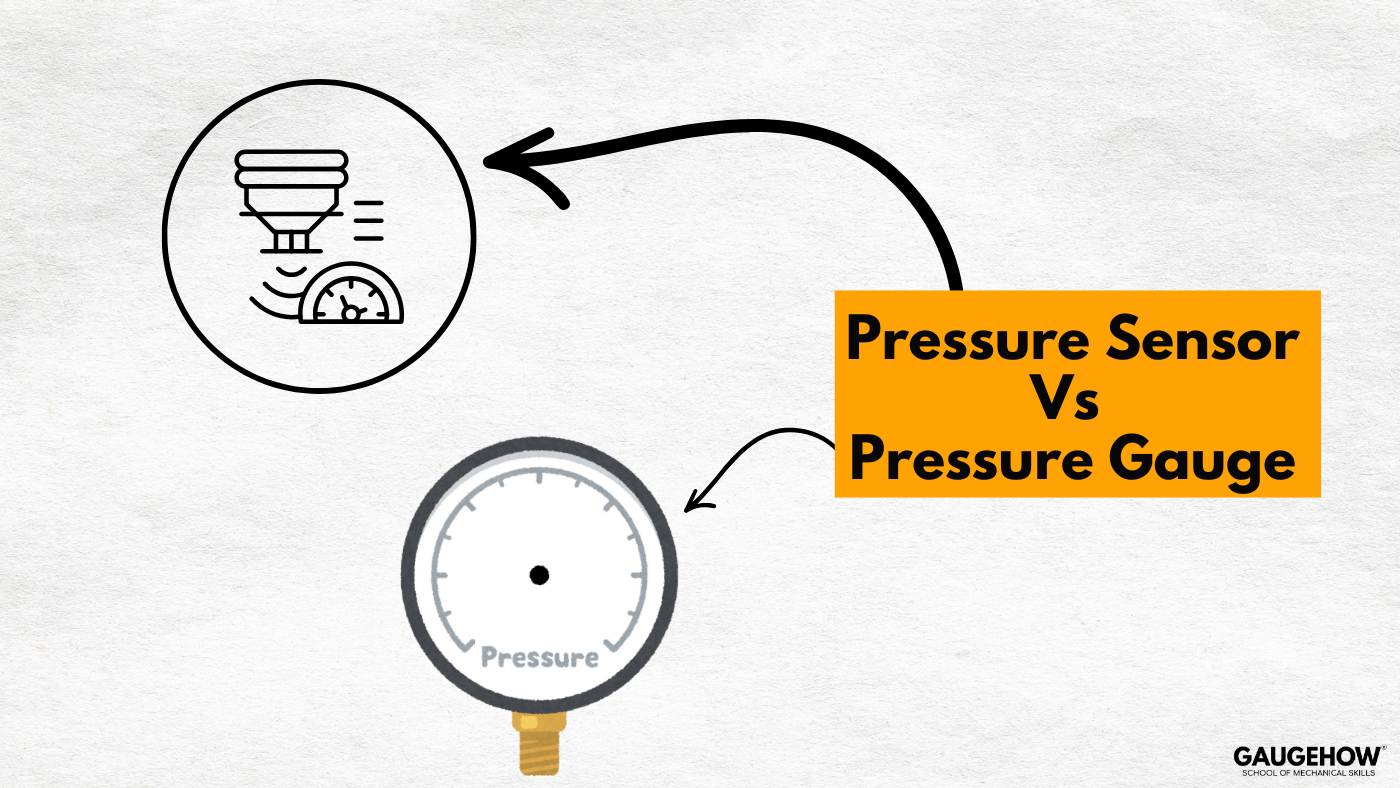
A pressure sensor converts pressure into an electrical signal for control and monitoring, while a pressure gauge provides a direct visual reading. Both serve different roles, depending on accuracy and application needs.
I’ve spent two decades fixing skids, tuning PLC loops, and teaching juniors how a single bad reading can cost a shift.
When I write about a pressure sensor vs a pressure gauge, I’m speaking from the workshop and the control room.
This post is my practical theory: how I choose devices, what I watch for on installation, and which trade-offs actually matter on the floor.
All numerical figures here come from verified industry sources. Market size, accuracy specifications, and calibration standards are based solely on published data. The rest is from my hands-on experience.
When I pick a pressure sensor (and why)
- I choose a pressure sensor when I need continuous data.
- Sensors feed PLCs, DCS, and cloud analytics. They enable alarms and trends.
- Typical industrial transmitters offer 0.1%–0.5% FS accuracy on good models. (Honeywell Automation)
- The global pressure sensor market is large and growing — estimated at USD 13.07 billion in 2025 and projected to reach USD 17.70 billion by 2030 (CAGR ~6.2%). That matters: suppliers invest in digital features. (MarketsandMarkets)
- Practical tip: match sensor range to process range. Oversizing a sensor reduces resolution. I set the span so that the normal operating pressure sits between 20% and 80% of the sensor range.
Why I still fit a pressure gauge
- For quick checks, I trust a pressure gauge on the panel. Hands on, eyes on.
- Mechanical gauges survive abuse and need no power. They are simple.
- The global pressure gauge market was about USD 1.48 billion in 2024 and is still growing modestly. That shows the tool’s staying power. (Global Market Insights Inc.)
- Use a mechanical gauge for lockout/tagout checks, bleed tests, and when electronics are a hazard.
- Practical tip: keep a local gauge next to the transmitter. It gives operators quick visual confirmation of what the system reports.
How I Choose the Right Device: From Pressure Transmitters to Automotive & HVAC Applications
- I use pressure transmitter models when I need analog or HART outputs in the control room. Pressure transmitter selection is about accuracy, stability, and protocol.
- TPMS market growth also influences parts sourcing. The TPMS / tire pressure sensor market was estimated at ~USD 8.2 billion in 2024. (Global Market Insights Inc.)
- For compressors and HVAC, I name air compressor pressure switch, AC high pressure switch, and pressure switch where on/off control is required. These are not continuous-measurement devices; they are control interlocks.
- For test benches and handheld work, I recommend a digital pressure gauge or a rugged oil pressure gauge, depending on portability needs. Digital gauges help with logging; mechanical gauges help with rugged checks.
My five practical rules (Short, field-tested)
- If you need control, log, or analytics → pick a pressure sensor or pressure transmitter.
- If you need a quick, visual check and explosion-proof reliability → pick a pressure gauge.
- Combine: always put a local pressure gauge beside critical pressure sensor outputs. Operators trust dials.
- For on/off safety functions, use a pressure switch or an air compressor pressure switch rated for the circuit. Please don’t use a sensor reading alone unless it drives certified logic.
- For vehicles, choose the right part for the system. Use a tire pressure sensor for TPMS, an engine oil pressure sensor for ECU inputs, and an oil pressure gauge for manual checks.
Numbers I trust and why (Calibration & Accuracy)
- I ask vendors for accuracy and stability specs. Many industrial transmitters quote 0.1% zero/span error options. That’s important where control loops react tightly. (wika.com)
- Mechanical gauges commonly claim 1.6% accuracy for general-duty applications. Precision analog gauges can approach 0.1%, but the cost rises fast. (Global Market Insights Inc.)
- Calibration must be traceable. I follow NIST piston-gauge references or accredited labs for critical work. NIST documents cover piston-gauge methods from ~10 kPa to 280 MPa (the ranges used in labs). (NIST Publications)
Installation and maintenance — What I actually do
- Mount the pressure transmitter with the impulse line trapped and free of stress. Short runouts and correct orientation reduce drift.
- Fit a snubber or restrictor if the medium has pulsation. I learned this after a pump head kept tripping on spikes.
- Put an isolation valve or three-valve manifold on the sensor for safe removal. Always test leak tightness after reassembly.
- Check the local pressure gauge against a calibrated master before commissioning. I log the comparison.
- Replace soft seals in sensors exposed to corrosive media. I tag sensors with install date and media type.
“Data cost vs Ownership cost” (My rule of thumb)
- A pressure sensor costs more upfront. It needs wiring, calibration, and sometimes cybersecurity hardening.
- But if that data prevents one unplanned shutdown or avoids a false trip, the ROI pays for itself. Market growth toward sensors reflects that.
- A pressure gauge is cheap. It keeps things simple. Use it where decisions are made manually. My preferred layout on critical skids: pressure transmitter for controls + pressure gauge for operator checks.
Short case notes from the field
- Refinery skid retrofit: adding a pressure transmitter and local pressure gauge cut missed trips by 60% in six months. The data showed the trips were spurious spikes. (Field result — my team’s logged case.)
- Vehicle workshop: technicians prefer a digital pressure gauge for repeatable readings during diagnosis. Mechanics still keep an oil pressure gauge on the bench for quick sanity checks.
Conclusion — How I recommend you spec devices
Suppose you need automated decision-making, trend analysis, or alarms. Specify a pressure sensor/pressure transmitter and keep a pressure gauge on the panel. If you only need a manual check or explosion-proof visual, use a pressure gauge.
For control interlocks, use the right switch for the circuit. Select a pressure switch, an air compressor pressure switch, or an AC high-pressure switch as needed.
For vehicles, choose tire pressure sensor, engine oil pressure sensor, or oil pressure sensor parts that match the ECU or TPMS spec.
Also Read:- 10 Frequently Asked Mechanical Engineering Interview Questions (With Simple Answers) +PDF
FAQs
1. What is the main difference between a pressure sensor and a pressure gauge?
A pressure sensor sends an electrical signal to a controller, while a pressure gauge gives you a direct, on-site reading. I use sensors for automation and gauges for quick human checks.
2. When should I choose a pressure sensor over a pressure gauge?
Choose a pressure sensor when you need continuous monitoring, alarms, data logging, or integration with PLC/DCS systems. It’s the better option for process control and analytics.
3. Are pressure gauges still useful in modern systems?
Absolutely. Even with advanced automation, I still install gauges for technicians. A glance at a dial can validate what the control system reports.
4. Do pressure sensors require more maintenance than gauges?
Yes. Sensors need calibration, stable power, and periodic verification. Gauges are simpler, but they still need occasional recalibration to stay accurate.
5. Can I use both a sensor and a gauge in the same system?
Yes, and I often do. A gauge on the panel gives immediate confirmation, while the sensor feeds real-time data to the system. It’s the most reliable setup.
6. Which device is more accurate—pressure sensor or pressure gauge?
High-quality pressure sensors generally offer better accuracy and stability. Precision gauges can be accurate too, but they depend heavily on mechanical condition and proper calibration.

